
What’s new
Five basics to get right after this month’s cyber warnings
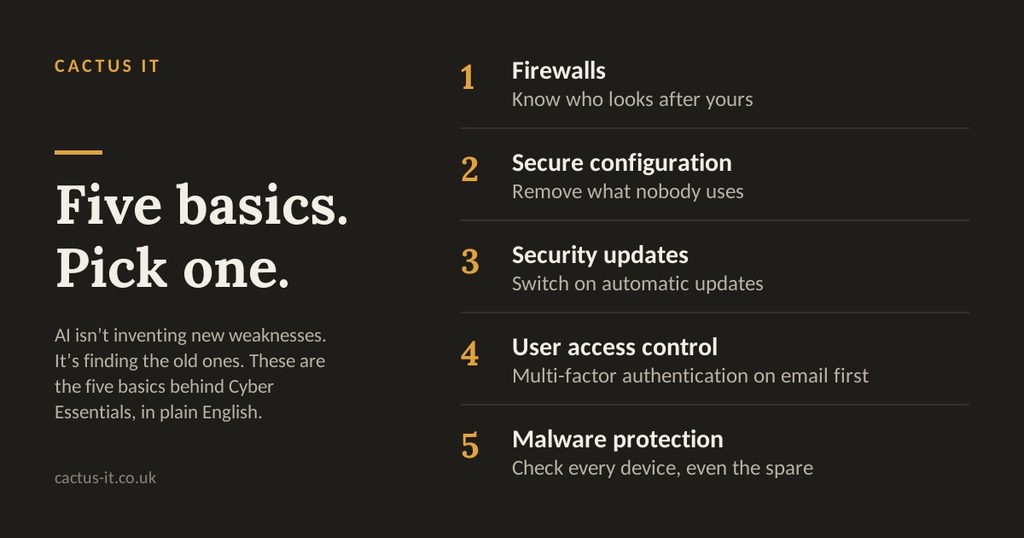
Another week, another warning. Earlier this month the NCSC said hostile states and criminal groups are highly likely to use AI to attack faster and on a bigger scale, and its advice is to get the basics right. For a small business, that means the five Cyber Essentials controls. The day before, a cyber attack overheated fridges and freezers in supermarkets across Europe. If you run a small business, it’s easy to read all that and feel there’s nothing you can do about it.
You didn’t start your business to become a security expert, and nobody should expect you to be. There’s also some reassuring news buried in the NCSC’s report. It says AI hasn’t created new weaknesses. It’s exposing old ones that have been put up with for too long: years of basics that were never quite finished. And it urges organisations to use the standards that already exist.
For a small business, the best known of those standards is Cyber Essentials. It rests on five technical controls, and each one comes with a worry that’s easy to recognise.
The five Cyber Essentials controls in plain English
For each one, here’s the worry that usually comes with it, and the one thing we’d do first.
1. Firewalls: the front door
A firewall filters what can reach your network from the internet. Most owners inherited theirs from whoever installed the broadband years ago, and have never looked at it. That’s normal. Start by finding out who looks after your router or firewall, and check that its default password has been changed.
2. Secure configuration: the locks
This means setting things up safely: removing accounts and software nobody uses, and changing the factory settings. Every business collects old logins and forgotten programs, usually because someone needed something done in a hurry. Start with a list of the accounts and software you actually use, and remove anything nobody can explain.
3. Security updates: fixing the known problems
Updates interrupt your day, so putting them off is only human. But Cyber Essentials expects supported software, with serious fixes applied within 14 days. The fridge attack shows why. In the UK the NCSC said the impact so far was minimal, but it pointed to organisations running systems past the end of their supported life while still connected to the internet. Start by switching on automatic updates, and list anything too old to update so you can plan to replace it.
4. User access control: who gets in
People share passwords because the work has to get done, and that’s rarely carelessness. The answer is to make the safe way the easy way: multi-factor authentication on email and cloud services, a separate account for administration, and a checklist for when someone leaves. Start with multi-factor authentication on email.
5. Malware protection: the guard on duty
Most businesses will tell you they have antivirus, and they usually do, apart from the spare laptop or the phone nobody remembered. Start by checking every device, and make sure someone would notice if the protection were switched off.
You don’t have to fix all five by Friday
Pick one and do it properly. That’s a real start, and more than many businesses manage.
When you’re ready for an independent check on the five Cyber Essentials controls, certification is how you show customers you’ve done it. Earlier this year the government launched a voluntary Cyber Resilience Pledge, which encourages companies to require Cyber Essentials across their supply chains. So more customers may begin asking their suppliers whether they hold it.
If it would help to have someone look at this with you, putting the five Cyber Essentials controls in place is the work we do every day. For one financial services firm that meant reaching Cyber Essentials Plus, the higher level that includes hands-on technical testing. You can read how that went here.
If you’d like to talk through where your business stands, get in touch. We’ll listen first, tell you honestly what we see, and only suggest what you actually need.
Sources: National Cyber Security Centre, Cyber chief: UK facing AI-powered attacks on critical infrastructure within two years, 3 November 2026. The Record, UK faces ‘unprecedented rise’ in cyberattacks in coming months, warns cyber chief. Information Governance Services, Supermarket fridge cyberattacks reach the UK as NCSC warns of AI-driven threats, 9 November 2026. GovConExec, NCSC AI ransomware warning, for the Cyber Resilience Pledge. NCSC, Cyber Essentials: Requirements for IT Infrastructure.